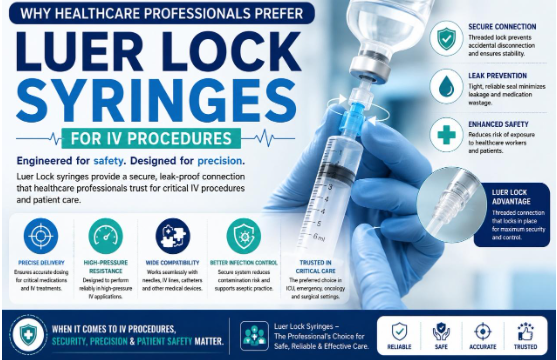
In modern healthcare settings, safety, precision, and reliability are critical during intravenous (IV) procedures. From medication administration and fluid delivery to emergency treatments and critical care, healthcare professionals rely heavily on high-quality medical devices to ensure patient safety and clinical accuracy.
Among the various syringe types available, Luer Lock syringes are widely preferred for IV procedures because of their secure locking mechanism, reduced leakage risk, and improved connection stability. Hospitals, clinics, laboratories, and emergency care units commonly use Luer Lock syringes in procedures where secure fluid handling is essential.
This article explains why healthcare professionals prefer Luer Lock syringes for IV procedures and how these syringes improve safety and efficiency in medical environments.
What Is a Luer Lock Syringe?
A Luer Lock syringe is a type of syringe designed with a threaded locking mechanism that securely connects the syringe to needles, IV lines, catheters, or other medical accessories.
Unlike standard slip-tip syringes where the needle is simply pushed onto the syringe tip, Luer Lock syringes require twisting the needle into place for a firm connection.
This locking system helps prevent accidental disconnections during medical procedures.
Importance of Secure Connections in IV Procedures
IV procedures involve direct administration of:
- Medications
- Fluids
- Blood products
- Nutritional solutions
- Emergency drugs
Any leakage, disconnection, or contamination during these procedures can create serious patient safety risks.
Healthcare professionals therefore prefer devices that provide:
- Stable connections
- Leak prevention
- Accurate fluid delivery
- Better handling control
Luer Lock syringes help achieve these requirements effectively.
1. Reduced Risk of Needle Disconnection
One of the biggest advantages of Luer Lock syringes is the secure threaded connection between the syringe and needle.
During IV procedures, accidental needle disconnection can occur because of:
- Pressure during injection
- Patient movement
- Handling errors
- High-flow medication delivery
The locking mechanism minimizes the possibility of the needle slipping off during use.
This is especially important in:
- Emergency care
- Intensive care units (ICUs)
- Critical medication administration
- High-pressure injections
2. Improved Leak Prevention
Fluid leakage during IV administration can result in:
- Medication wastage
- Dosage inaccuracies
- Contamination risks
- Exposure to hazardous drugs
Luer Lock syringes create a tighter seal between connected components, significantly reducing leakage risks.
This makes them highly suitable for administering:
- Chemotherapy drugs
- Contrast media
- Antibiotics
- Critical care medications
3. Better Safety for Healthcare Workers
Needle disconnections and fluid leaks may expose healthcare professionals to:
- Bloodborne pathogens
- Hazardous medications
- Infectious materials
Secure syringe systems help reduce occupational exposure risks.
This is particularly important in environments handling:
- Infectious diseases
- Cytotoxic medications
- Emergency blood samples
- Intensive patient care
4. Enhanced Precision During IV Medication Delivery
Many IV procedures require highly accurate medication dosing.
Luer Lock syringes help maintain stable connections and consistent pressure during administration, improving precision in:
- Pediatric dosing
- ICU medication delivery
- Anesthesia administration
- Infusion therapy
The secure attachment also allows smoother fluid control during slow injections.
5. Suitable for High-Pressure Applications
Certain medical procedures involve higher injection pressure, such as:
- Radiology contrast injections
- Specialized infusion therapies
- Catheter flushing procedures
Slip-tip syringes may occasionally loosen under pressure, while Luer Lock syringes are designed to withstand stronger force without disconnecting.
This makes them more reliable in demanding clinical situations.
6. Compatibility With Multiple Medical Devices
Luer Lock systems are widely standardized across medical equipment.
They are compatible with:
- IV cannulas
- Catheters
- Extension lines
- Infusion systems
- Needles
- Three-way stopcocks
This universal compatibility improves convenience and workflow efficiency for healthcare providers.
7. Better Infection Control
Infection prevention is a major priority in healthcare settings.
Loose syringe connections can increase contamination risks during IV procedures.
The secure locking mechanism helps maintain a closed system, reducing chances of:
- Fluid exposure
- External contamination
- Accidental spills
This supports safer injection practices and infection control protocols.
8. Preferred in Critical Care Settings
Luer Lock syringes are commonly used in:
- ICUs
- Emergency departments
- Operating rooms
- Oncology units
- Neonatal care
- Surgical procedures
In these environments, even minor connection failures can create serious complications.
Healthcare professionals therefore prioritize reliable syringe systems.
Luer Lock Syringe vs Luer Slip Syringe
Understanding the difference between the two syringe types explains why Luer Lock syringes are preferred for IV use.
Luer Lock Syringe
- Uses threaded locking connection
- More secure attachment
- Better leak prevention
- Suitable for high-pressure procedures
- Preferred for critical care applications
Luer Slip Syringe
- Push-fit connection
- Faster attachment
- Suitable for low-pressure procedures
- Higher risk of accidental disconnection
Both syringe types have medical applications, but Luer Lock syringes are generally favored where connection stability is critical.
Applications of Luer Lock Syringes in Healthcare
Healthcare professionals use Luer Lock syringes for:
- IV medication administration
- Blood collection
- Chemotherapy delivery
- Radiology procedures
- ICU treatments
- Anesthesia injections
- Laboratory applications
- Infusion therapy
Their versatility makes them essential across multiple healthcare departments.
Importance of Quality in Luer Lock Syringes
Healthcare facilities prioritize high-quality syringes manufactured according to international medical standards.
Key quality considerations include:
- Sterility
- Leak-proof performance
- Medical-grade materials
- Accurate calibration
- Smooth plunger movement
- Secure locking mechanism
Poor-quality syringes may compromise patient safety and clinical performance.
Role of Disposable Luer Lock Syringes
Disposable single-use Luer Lock syringes help reduce:
- Cross-contamination
- Infection transmission
- Sterilization burden
- Reuse-related safety risks
They are now standard in most healthcare settings worldwide.
Future of Syringe Safety Technology
Medical syringe technology continues evolving toward improved:
- Needle safety systems
- Auto-disable mechanisms
- Infection prevention
- Precision drug delivery
- User ergonomics
Luer Lock systems remain an important part of safe injection practices and IV procedure management.
Final Thoughts
Healthcare professionals prefer Luer Lock syringes for IV procedures because they provide secure connections, reduce leakage risks, improve dosing accuracy, and support safer clinical practices.
Their threaded locking mechanism offers greater reliability during critical medical procedures, making them especially valuable in emergency care, ICUs, surgical settings, and high-pressure applications.
As healthcare standards continue emphasizing patient safety and infection control, Luer Lock syringes remain one of the most trusted and widely used syringe systems in modern medicine.